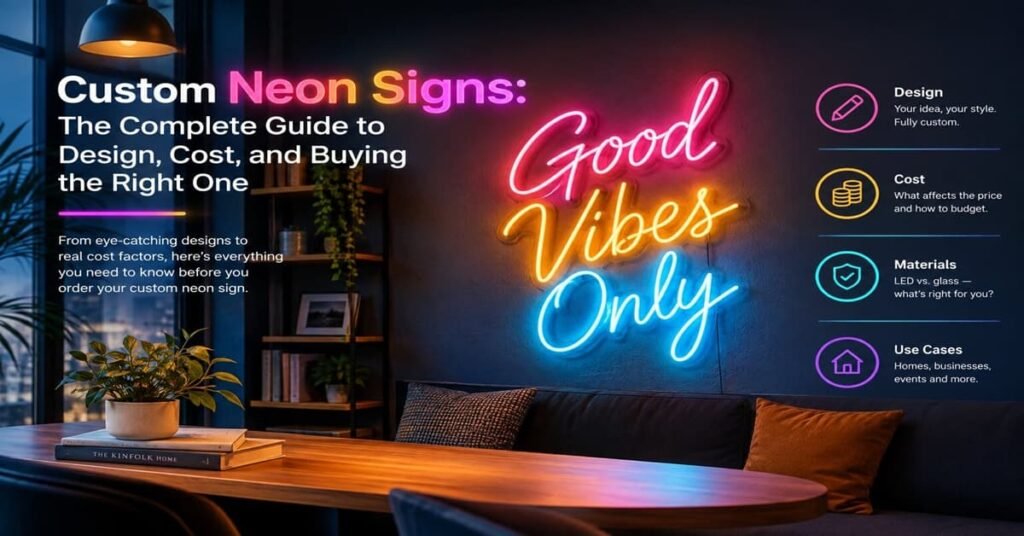
A neon sign is one of the few things that can make a boring wall interesting in under a second. No paint job does that. No poster does that. That’s probably why custom neon signs have gone from a 1920s advertising gimmick to a fixture in homes, cafes, offices, and wedding venues around the world.
But ordering one is not as simple as picking a font and a color. The price range is wide, the materials are different from what most people expect, and a sign that looks great on a phone screen can look completely wrong on your actual wall. This guide walks through what these signs are, how they’re made, what they cost, and how to order one without regret.
What Counts as a Custom Neon Sign Today
The term “neon sign” gets used loosely now, and that’s worth clearing up first. Traditional neon signs use thin glass tubes bent by hand into letters or shapes, then filled with neon or argon gas. When electricity runs through the gas, it glows. This is real neon, the same technology that lit up storefronts in the early 1900s. Most signs sold today under the name custom LED neon signs are not glass at all.
They use flexible LED strips inside a silicone or acrylic tube shaped to look like glass neon. They’re lighter, harder to break, cost less to run, and can be shipped without a crate full of bubble wrap. Almost every “custom made neon signs” business you’ll find online, especially ones selling for home decor or small business use, works with LED rather than glass. Both versions fall under the same buyer search: personalized neon signs.
Whether someone wants their name in cursive above a bed or a logo glowing behind a reception desk, the sign is built to their exact wording, shape, and size rather than picked off a shelf. That’s the whole point of “custom” here. Nothing is mass produced.
A Quick (and Actually Interesting) History of Neon
Neon gas was identified in 1898 by chemists William Ramsay and Morris Travers while they were separating gases from liquid air in a London lab. They noticed a new gas that glowed a bright reddish orange in a discharge tube, and named it neon, from the Greek word for “new.” The commercial sign side came later. French engineer Georges Claude developed a practical neon lighting tube and showed it publicly around 1910, then began selling neon signs through his company in the 1920s.
The first big splash in the United States came when a Packard car dealership in Los Angeles installed two neon signs in 1923. People reportedly stopped their cars in the street just to look at them, which is either the earliest recorded case of distracted driving or the best sign review in history. Neon dominated American advertising for decades before falling out of fashion when cheaper plastic and fluorescent signage arrived. It never fully disappeared, and in the last ten years it has come back hard, this time mostly through LED, in cafes, bars, home offices, and Instagram backdrops everywhere.
Why Businesses Still Choose Neon Advertising Signs
Here’s the thing about running a business with a plain signboard: it works, but it doesn’t stop anyone. Neon advertising signs do a specific job that flat signage can’t. They glow, they draw the eye at night, and they give a location a personality before a customer even walks in.
Neon business signs show up most often in three places:
- Retail storefronts, where an open sign or a brand name in neon does double duty as decor and as a beacon that’s visible from the street after dark.
- Neon restaurant signs, which are almost a genre of their own. A glowing “eat” sign or a restaurant’s name in script has become shorthand for a certain kind of casual, photogenic dining spot.
- Office neon sign installations, usually behind a reception desk or in a break room, showing the company name, a motivational line, or a logo. These have become common enough that some companies now treat them the way they used to treat a framed mission statement on the wall.
The logic behind all of this is simple: light draws attention, and attention is free advertising every single night the sign is switched on. A business signage specialist like DXB Signage works with exactly this category, building illuminated signs designed to hold up under daily commercial use rather than the lighter demands of a bedroom wall.
Custom Logo Neon Signs for Branding
A logo is usually built for flat surfaces: a website header, a business card, a truck door. Turning that same logo into light is a different exercise, because not every shape bends well into a tube, and small details in a logo can vanish once it’s lit up on a wall. Custom logo neon signs work best when the logo has clean, simple lines. A wordmark with a distinct font, a simple icon, or a logo with two or three colors will translate cleanly.
A logo packed with fine detail, gradients, or thin serif text usually needs to be simplified before it can be built as a sign. A decent sign maker will flag this at the design stage rather than after the sign is built, so ask about it up front. These signs show up most in offices, retail counters, gyms, and salons, anywhere a brand wants to feel established rather than temporary. A logo sign behind a desk also does something a printed logo can’t: it stays lit after closing hours, so a storefront with the lights off at night still has a glowing brand mark visible from outside.
Personalized Neon Signs for Home and Personal Use
This is the category that pushed neon back into the mainstream. Personalized neon signs for bedrooms, home bars, nurseries, and home offices have become one of the most searched sign types online, mostly driven by home decor trends and social media. The most common request in this space is a neon name sign, someone’s own name, a couple’s names, or a child’s name rendered in a cursive or handwritten-style font. A close cousin is the neon light name sign made for a business owner’s first name or a pet’s name, which sounds unusual until you realize how often people name small shops after themselves or their dog.
A few things make personalized signs work well in a home:
- Keep wording short. Long phrases either need a huge sign or shrink the text to the point where it’s hard to read from across the room.
- Match the backboard shape to the wall. A rectangular backboard is easiest to hang, but a cut-to-shape backboard around the letters looks more finished.
- Think about placement before ordering. A sign that glows well on a dark wall can wash out completely against a white one under bright daylight.
Home buyers usually go with LED rather than glass, since LED signs run cooler, use a standard low-voltage plug, and don’t carry the fragility of glass tubing around kids or pets.
Neon Signs for Weddings and Events
If there’s one place neon signs have completely taken over, it’s weddings. A custom neon sign wedding display has become close to standard at receptions, usually placed behind the head table, near the entrance, or as a backdrop for photos. The most requested phrase in this category, by a wide margin, is some version of “happily ever after neon sign.”
It’s become a stock phrase the same way “just married” is on a car, recognizable and expected, which is exactly why some couples now deliberately avoid it and go for their own wedding date, initials, or an inside joke instead. A neon wedding sign usually gets rented rather than bought outright, since most couples only need it for one evening.
Rental makes sense financially, but if a couple wants to keep the sign afterward as a piece for their new home, buying it outright is common too, and a lot of sign companies design specifically with that dual use in mind. Beyond weddings, the same category covers birthdays, engagement parties, and baby showers, where a sign with a name and date acts as both decoration and a photo prop for guests.
Neon Sign Cost: What Actually Drives the Price
This is the section everyone actually came here for, so let’s break it down honestly instead of throwing out a number that may not apply to your order at all.
Neon sign cost depends on several factors, and any of them can move the price up or down significantly:
- Length of wording and size of the sign. More letters means more tubing or LED strip, more backboard material, and more labor. This is usually the single biggest driver of neon sign price.
- Material choice. Real glass neon costs more to make, ship, and repair than LED. It also usually needs a professional for installation and any future fix.
- Font and complexity. A simple block font is cheaper to produce than an intricate script with lots of curves, since curves take more time to shape and mount correctly.
- Color count. A single-color sign is the standard price point. Multi-color signs cost more because they need separate circuits or sections that can be controlled independently.
- Backboard style. A plain rectangular acrylic backboard is the cheapest option. A custom-cut shape that follows the outline of the letters or logo adds cost.
- Indoor vs outdoor use. Outdoor signs need weatherproofing, sealed wiring, and mounting hardware rated for wind and rain, which pushes the price above an equivalent indoor sign.
- Dimming and remote control. Basic on and off wiring is standard. Adjustable brightness or a remote control adds a small amount to most quotes.
Because so much depends on the specifics of one order, honest sign makers give a quote after seeing the design rather than a flat number upfront. Anyone quoting a firm price before seeing your text, size, and intended location is either working from a very limited catalog or guessing. If you want an accurate figure for your own project, the fastest route is to send your wording and rough size to a supplier directly and ask for a written quote, rather than relying on prices you saw for someone else’s completely different sign.
Custom Neon Signs Dubai: Local Considerations
Searches for custom neon signs Dubai carry a few extra requirements that don’t show up in a general guide, mostly because of climate and how the city regulates outdoor advertising. Heat and humidity matter more here than almost anywhere else. A sign built for a mild climate can degrade faster in Dubai’s summer temperatures if the materials and adhesives aren’t rated for sustained heat.
LED strips and acrylic backboards used outdoors need UV-resistant coatings, or the color can fade and the material can warp within a year or two. Outdoor commercial signage in Dubai also typically needs approval from the relevant municipal or free zone authority before installation, depending on the building and location. This is one of the reasons businesses tend to work with a local signage company rather than importing a sign from overseas:
A local supplier already knows what documentation a landlord or authority will ask for, and can build the sign to match approved dimensions and mounting methods from the start. DXB Signage operates directly in this market and deals with exactly this mix of design, materials, and local requirements for both indoor and outdoor commercial signs. For home and event use inside Dubai, the climate consideration is smaller since the sign stays indoors, but it’s still worth confirming the material is suited to air-conditioned spaces that can swing in humidity depending on the season.
LED Neon vs Traditional Glass Neon: Which One Should You Pick
Custom-built neon light signs today almost always come down to a choice between two materials, and each suits a different kind of buyer. It produces a slightly different quality of light, often described as warmer or more diffused, since the gas glows through the full width of the glass tube. It’s fragile, needs a specialist for repairs, uses higher voltage, and costs more both to buy and to maintain. It also generates more heat, which matters if the sign hangs somewhere with limited ventilation.
LED neon uses small LED bulbs housed inside a flexible tube, giving a similar look at a lower cost. It’s shatter-resistant, runs on low-voltage power that’s safer around kids and pets, uses far less electricity, and can be shipped without the packaging headache of glass. The tradeoff is that up close, LED neon has small visible dots of light rather than the smooth glow of true gas discharge, though from normal viewing distance most people can’t tell the difference.
For a first sign, especially for home use, a wedding, or a small business, LED is the practical choice for almost everyone. Glass still holds its place in vintage restoration projects, collector pieces, and businesses that specifically want the exact look and history of original neon.
How to Order a Custom Sign Without Regretting It
Most regret with custom signs comes down to skipping a design step, not from poor manufacturing. A few habits fix most of the common issues before the sign is even built: Measure the actual wall space first, not just a guess. Text that looks reasonably sized in a design mockup often looks smaller in person than expected once it’s mounted.
- Ask for a digital proof before production starts. A reputable maker will send a mockup showing your exact wording, font, and color on a scaled backboard so you can catch spacing issues early.
- Pick a font for readability, not just style. Elaborate scripts look great in short names but can become hard to read once a phrase runs past five or six words.
- Confirm the mounting method matches your wall. Drywall, brick, glass storefronts, and outdoor facades all need different hardware, and this should be settled before the sign ships, not after.
- Check the power setup. Know where the nearest outlet is and whether the sign needs a plug-in adapter, a dimmer, or a remote, since retrofitting this later is more work than planning it upfront.
Skipping the proof stage is the single most common mistake buyers make. It’s tempting to approve a design fast and get the sign moving, but a five-minute review of the mockup can save weeks of waiting for a replacement.
Common Mistakes People Make With Custom Signs
A few patterns show up again and again with first-time buyers:
- Choosing a color based on a photo, not a swatch. Neon colors photograph differently under different lighting, and a shade that looked perfect in someone else’s Instagram post can look completely different against your own wall color.
- Underestimating wording length. Every extra word adds width, and a sign meant for a small nook can end up too large once the actual phrase is laid out.
- Forgetting outdoor signs need different specs than indoor ones. A sign built for a living room wall is not built to survive rain, and using one outdoors will shorten its life fast.
- Assuming all “neon” signs are the same product. As covered above, LED and glass neon are genuinely different materials with different costs, weights, and maintenance needs. Confirming which one you’re buying avoids a surprise later.
Frequently Asked Questions
How long do custom neon signs last?
LED neon signs typically run for tens of thousands of hours of use before the brightness noticeably drops, which for most buyers works out to several years of regular use. Glass neon signs can last for decades if the glass stays intact and the transformer is maintained, though they’re more vulnerable to physical damage.
Do neon signs use a lot of electricity?
LED neon signs use very little electricity compared to glass neon, similar to a string of LED holiday lights. Glass neon uses more electricity because it runs on a high-voltage transformer, though it’s still far less than most people assume.
Can I get any shape or logo made into a sign?
Most shapes and logos can be made, but very fine detail, thin gradients, or extremely small text may need to be simplified first. A good supplier will tell you this during the design proof stage rather than after production.
Are custom neon signs safe indoors?
Yes, when installed correctly. LED neon signs run on low, safe voltage similar to standard home electronics. Glass neon should be installed by someone experienced with high-voltage transformers, and should be kept away from areas where it could be knocked or hit.
Is renting or buying better for a wedding sign?
Renting makes sense if the sign is only needed for one event and won’t be reused. Buying makes more sense if the couple wants to display it in their home afterward, since the cost difference between a rental and a purchase is often smaller than people expect.
Final Thoughts
A custom neon sign is one of the few decor or advertising choices that pays you back in attention every single time someone walks past it lit up. The part that actually determines whether you’re happy with it isn’t the neon itself, it’s the decisions made before the sign is built: the wording, the size, the material, and whether someone checked the proof before production started.
If you’re ready to move from research to an actual design and quote, working with a supplier who handles both the design proof and local installation requirements, like DXB Signage, takes most of the guesswork out of the process.