Table of Contents
A good sign has one job before anything else: help people notice, read, and recognise a business. A light box does that by placing a light source behind a printed acrylic, fabric, or translucent sign face. The result is a display that stays visible in low light and can give a shop, restaurant, office, mall unit, or exhibition space a clear branded presence.
This light box signage guide explains the basics without burying you in sign-shop language. You will learn what a light box is, how it works, which types suit different spaces, what materials matter, how LED systems compare with older lighting methods, what affects cost, and what to check before you approve an order.
What Is a Light Box?
A light box is an illuminated sign or display with a frame, an internal light source, and a face that lets light pass through. The face may carry a logo, business name, poster, menu, advertisement, or full graphic. In many current systems, LEDs sit inside or around the frame and spread light across the sign face. The sign can use a rigid acrylic panel, translucent printed film, tensioned flex, or fabric, depending on the size and use.
A light box differs from a front-lit sign. In a light box, the light usually comes from behind the visible graphic or face. This is why people also use terms such as backlit light box, illuminated sign box, lightbox sign, and LED light box sign. Brightness still needs good design. A badly spaced logo with weak contrast can glow beautifully and still make people squint. That is an expensive way to create a puzzle.
How Light Box Signage Works
A typical light box has five main parts:
- Frame: Usually aluminium or another suitable structural material.
- Light source: Commonly LED modules or LED strips.
- Electrical components: Drivers, wiring, connectors, and related parts.
- Sign face: Acrylic, flex, fabric, or a film-based graphic.
- Mounting system: Wall brackets, hanging points, concealed fixings, or another site-specific method.
Uniform lighting matters. If LEDs sit too close to the face, or if the layout does not match the depth of the box, you may see bright dots or dark zones. Sign makers often call these hot spots. 3M’s technical guidance for backlit signs recommends methods such as reflective internal surfaces and suitable diffuser film to help produce more even illumination. It also explains that inefficient internal light handling can affect the visible result. What this really means is that a light box is more than a glowing frame. The depth, LED layout, face material, internal reflectivity, and print all work together. If one part is wrong, the finished face may look patchy.
Types of Light Box Signs
There is no single best type. The right option depends on size, viewing distance, graphic-change frequency, indoor or outdoor use, and the visual finish you want.
LED Light Box
An LED light box uses light-emitting diodes as its internal light source. LEDs are now common in illuminated signs because they can provide long service life and efficient lighting in a compact space. The U.S. Department of Energy states that good-quality white LED products can have useful lives of 30,000 to 50,000 hours or more. It also points out that overall reliability depends on more than the LED chips because electronic parts can fail earlier. That last point matters. Buying an LED sign is not the same as buying a lifetime promise. Ask about the LED modules, driver access, heat management, wiring, warranty, and how a failed part can be replaced.
Poster Light Box
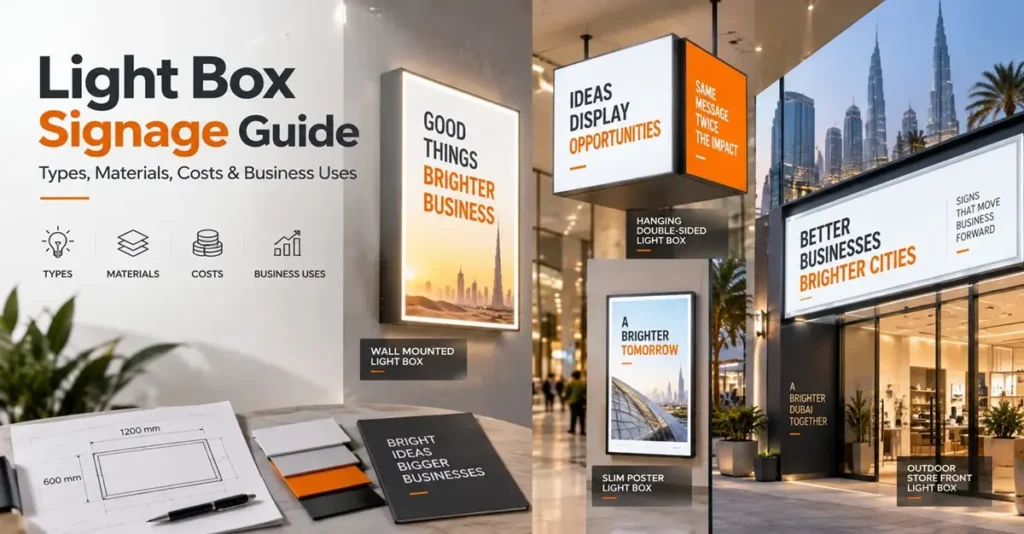
A poster light box frame holds a replaceable printed poster in front of an illuminated panel or lighting system. This format suits menus, cinema posters, retail campaigns, property displays, promotions, and other graphics that change often. A poster system makes sense when staff need to swap artwork without replacing the whole sign. Some frames open from the front, while other designs use removable panels or snap-style edges. DXB Signage offers poster light box systems for commercial poster displays with illuminated configurations.
Fabric Light Box
A fabric light box uses a printed textile graphic fitted into a frame, often with silicone edging sewn around the fabric. The edge fits into a narrow channel and keeps the face tensioned. Fabric systems work well for large indoor graphics because the face can remain smooth while the frame stays relatively slim. They also make graphic replacement practical for campaigns, retail displays, showrooms, events, and branded interiors.
DXB Signage’s fabric light box range combines printed fabric, an aluminium frame, and internal LED lighting.
Flex Face Light Box
A flex face system uses a flexible translucent face tensioned across a frame. It is often chosen for larger illuminated signs where a single rigid sheet would be difficult to handle or less practical. This type can work well for large storefronts, commercial buildings, retail units, and other broad sign areas. The tensioning system keeps the graphic face flat. For bigger formats, compare DXB Signage’s flex face signage options and flex face light box signs. The listed systems include aluminium frames, printed flexible faces, and LED illumination options.
Acrylic Light Box Sign
An acrylic light box sign uses acrylic as part of the visible face or sign construction. Acrylic can give a clean, rigid finish and works well for logos, smaller sign boxes, office displays, retail signs, and selected outdoor applications when the full specification suits the site. Acrylic should not be chosen by appearance alone. Thickness, span, support, temperature, exposure, and fixing method all matter. Large panels need proper support because every sheet material has limits. DXB Signage also provides acrylic signage boards with illuminated, edge-lit, and backlit options.
Slim Light Box
A slim light box uses a shallow frame to create a neat profile. It is common for indoor posters, retail graphics, menu displays, and wall-mounted promotional signs. Slim frames save depth, but they give the lighting designer less space to blend the light. Good LED spacing, diffusion, and internal optical design become more important as the frame gets shallower.
Wall Mounted Light Box
A wall mounted light box attaches directly to a wall or façade. It can display a fixed brand graphic, a replaceable poster, or another illuminated face. The wall matters as much as the box. Before fabrication, check the wall material, fixing points, cable route, sign weight, access for installation, and future service access. DXB Signage’s wall-mounted signage options include lit and non-lit systems for commercial settings.
Hanging Light Box
A hanging light box hangs from a ceiling, bracket, or overhead support. Double-sided versions work well where people approach from two directions, such as mall corridors, retail aisles, exhibitions, and indoor commercial spaces. The key issue is support. A hanging sign needs suitable fixing points and a safe installation method. The frame should also sit high enough to avoid interfering with people or nearby fittings. For related suspended displays, DXB Signage has hanging signage options in acrylic, metal, fabric, and illuminated builds.
LED Light Box vs Light Box
The phrase LED light box vs light box can sound confusing because an LED light box is still a light box. Usually, the real comparison is LED lighting versus older light sources such as fluorescent tubes. LEDs allow slim sign construction, flexible module placement, and long service life when the system uses suitable components.
The Department of Energy reports that quality LED lighting can operate for tens of thousands of hours, though the service life of the full product also depends on its electronic parts. For a new light box for business, LEDs often make sense because modules can be placed to suit the frame depth and face. Quality still varies. Weak modules, drivers, heat control, or spacing can turn a new sign into a service call.
Backlit vs LED Light Box: What Is the Difference?
Backlit vs LED light box is not a strict either-or comparison. Backlit describes where the light comes from. LED describes the type of light source. A sign can be both backlit and LED-lit. In fact, many current backlit signs use LEDs behind the visible face. A backlit sign could also use another light source, especially in an older installation.
If you are comparing styles, ask a better question: do you want the full graphic face illuminated, or do you want light around individual letters or a logo? A full light box display sends light through a broad face. Backlit lettering, sometimes called halo-lit lettering, sends light behind raised letters and onto the wall. Those systems create very different looks. For letter-based branding, DXB Signage’s backlit signage options cover LED and halo-lit sign formats.
Indoor vs Outdoor Light Box Signs
An indoor sign and an outdoor sign may look similar in a photo, but the working conditions can be very different.
Indoor Light Box Signs
Indoor displays usually face controlled conditions. They may suit retail walls, menu areas, malls, reception spaces, office interiors, exhibition stands, and showrooms. For indoor use, check viewing distance, wall or ceiling space, glare, graphic-change frequency, cable access, frame depth, cleaning access, and customer flow. A poster frame near a checkout may need quick graphic changes, while a showroom fabric display may need a much larger face.
Outdoor Light Box Signs
An outdoor light box has more work to do. It may face heat, dust, rain, sunlight, wind, cleaning, building movement, and long operating hours. The complete sign needs a suitable outdoor specification. That includes the enclosure, face, seals, drainage approach where required, electrical parts, fixings, coatings, and installation method. UL Solutions states that electric-sign safety work can include moisture, corrosion, wiring, components, and suitability for dry, damp, or wet locations. UL 48 is a U.S. standard, so it does not replace UAE rules, but it shows why outdoor electrical signage needs a location-specific specification.
For Dubai projects, local rules also matter. RTA released an updated Dubai Out-of-Home Advertising Manual in August 2024 with guidance covering sign locations, design, commercial signage, traffic safety, spacing, and newer advertising formats. Dubai Municipality also lists permit services for advertising on buildings and land. Check the relevant authority, property manager, free-zone requirements, and site conditions before fabrication.
Light Box Sign for Business: Where Does It Work Best?
A light box sign for business works best when illumination solves a real visibility or display problem. Common uses include shop names, restaurant branding, café menus, salon signs, mall units, office reception displays, cinema posters, real-estate displays, exhibition graphics, product campaigns, and wayfinding points. The format is especially useful in spaces that stay open after dark or sit in areas with mixed lighting. Still, a light box is not always the right answer.
If the location already has strong ambient light and the sign only needs a small room name, a simple non-lit panel may do the job. If the main goal is architectural lettering, channel letters or backlit letters may fit better. A good sign choice begins with purpose, not with a catalogue. For a wider look at shopfront, indoor, outdoor, directional, and illuminated formats, the DXB Signage business signage guide provides useful related context.
Custom Light Box Signage: What Can You Change?
Custom light box signage can be built around the brand, site, and message. Common choices include size, frame depth, one-sided or double-sided construction, wall or hanging installation, face material, frame finish, lighting layout, service access, and cable entry. A custom light box sign should begin with site measurements and artwork.
A scaled visual on a real site photo can catch problems early. For example, a 2-metre-wide sign may sound large during a phone call. On a wide shopfront, it might look tiny. On a narrow reception wall, it might look like the wall is wearing the sign rather than the other way around.
Poster vs Fabric Light Boxes: Which Display Should You Choose?
Poster and fabric systems both create illuminated graphics, but they solve different jobs. Choose a poster light box when the artwork changes often, standard poster sizes matter, and staff need quick access. It works well for menus, promotions, property listings, entertainment posters, and campaign graphics. Choose a fabric light box when you want a larger graphic area, a soft printed face, clean edge-to-edge presentation, and easy replacement of a tensioned fabric graphic.
For a small promotion near a counter, a poster frame may be simpler. For a large feature wall in a retail store, fabric can create a cleaner broad display. The best choice depends on size, how often the graphic changes, who will replace it, and what the customer sees from normal viewing distance.
Slim LED vs Snap Frame Light Boxes
A slim LED box focuses on shallow depth. A snap frame focuses on fast poster access. Some products combine both ideas, but do not assume every slim frame opens quickly or every snap frame has the same lighting quality. Choose a slim LED unit when wall depth matters and the graphic stays in place for longer periods. Choose a snap frame when staff need to change printed posters often without specialist tools.
Check the opening method before buying. A frame installed behind a counter may look simple until someone discovers that the front cannot open because a shelf sits three centimetres above it. Small planning mistake, big comedy for everyone except the person replacing the poster.
How to Choose a Light Box Size for Your Shop
Do not choose size from a product list alone. Start with the real viewing point.
Ask four questions:
- How far away will people first see the sign?
- What must they read?
- How much wall or façade space is available?
- What objects compete for attention nearby?
Letter size should grow as viewing distance increases. Contrast and font choice also affect legibility. The U.S. Access Board links minimum character size with viewing distance in its visual-sign guidance. It also calls for light-on-dark or dark-on-light contrast and non-glare finishes. These are useful design references, though UAE rules take priority for projects in the UAE. Make the business name or main message the first thing people notice.
Do not fill every empty corner with phone numbers, services, social handles, slogans, and five badges. A light box is a sign, not a tax return. For shopfronts, ask for a visual mock-up placed on a straight-on photo and an approach-angle photo. If the sign sits above eye level, check how the viewing angle changes readability.
Backlit Film vs Fabric Graphics for Illuminated Displays
Backlit film is commonly used for clear printed graphics in poster boxes and rigid display systems. Fabric graphics use printed textile held under tension in a suitable frame. Backlit film works well for smaller or medium displays where detail, image sharpness, and flat presentation matter. 3M produces translucent films for illuminated signs and publishes technical material for backlit sign construction.
Fabric works well for broad displays, branded walls, exhibition graphics, and retail areas where a tensioned textile face gives a clean finish. Your choice should also account for how often staff change the graphic, how the print will be stored, and whether the frame has been made for that face type.
Best Material for Light Box Signage
There is no single best material for light box signage. The right material is the one that fits the size, location, image, and change schedule.
Acrylic
Acrylic gives a rigid face and a clean finish. It suits many logo boxes, small to medium illuminated signs, and selected branded panels.
Translucent Film
Translucent film can carry printed graphics or coloured areas on a rigid clear or diffusing substrate. It is common in illuminated branding and graphic applications.
Flex Face Material
Translucent flex works well for large sign faces because the material can be tensioned over a frame.
Fabric
Fabric suits indoor retail, exhibition, showroom, and feature-wall displays where large printed graphics and easy face replacement matter.
Aluminium
Aluminium is common for frames and sign bodies because it offers low weight, workable fabrication, and corrosion resistance when specified and finished correctly. Material names alone are not enough. Ask for the exact product, thickness, finish, print method, intended location, and warranty terms.
How to Choose a Light Box Sign
Here is a practical buying process.
1. Define the Job
Write one sentence that explains what the sign must help customers do: find the shop, read a menu, notice a promotion, or confirm they reached the right office.
2. Measure the Site
Record width, height, depth limits, nearby doors, ceiling height, wall type, electrical route, and any obstacles.
3. Check Viewing Distance
A sign read from three metres has different needs from one seen across a road or mall corridor.
4. Pick the Face System
Choose poster, acrylic, film, flex, or fabric based on size and graphic-change needs.
5. Pick the Mounting Method
Decide whether the sign should be wall-mounted, suspended, projecting, freestanding, or built into another structure.
6. Plan Service Access
Ask how technicians can reach the graphic, LEDs, drivers, and wiring later.
7. Review Day and Night Appearance
A sign may look balanced in daylight but too bright, too dark, or uneven at night. Review both conditions for major exterior signs.
8. Confirm Approvals
For Dubai projects, check property rules and the relevant authority before production. The Dubai OOH Advertising Manual covers many external advertising and commercial sign formats, while Dubai Municipality provides related permit services.
Light Box Signage Cost: What Changes the Price?
There is no honest single price for all light boxes. A small indoor poster frame and a large outdoor flex-face sign are different products.
Light box signage cost usually changes with:
- Overall dimensions
- Frame depth and construction
- Single-sided or double-sided design
- LED quantity and grade
- Driver and electrical component quality
- Acrylic, fabric, flex, or film choice
- Print method
- Custom shape
- Outdoor sealing and finish
- Mounting hardware
- Installation height
- Access equipment
- Site electrical work
- Permit or approval work
- Removal of an old sign
- Graphic replacement requirements
- Warranty and service scope
Ask for a written quote that separates design, fabrication, printing, lighting, installation, access equipment, approval work, and optional items. A low quote can be perfectly valid. It can also be missing half the job. Comparing totals without comparing scope is how a bargain learns to send invoices later.
Outdoor Lighted Sign Boxes for Businesses
For outdoor lighted sign boxes for businesses, focus on four areas: weather exposure, electrical safety, structural fixing, and service access. Ask the supplier to confirm that the full assembly suits the location. A covered mall entrance and an exposed roadside façade do not face the same conditions. Check how water can enter or leave the enclosure, how metal parts resist corrosion, where electrical components sit, and how technicians can reach them.
UL’s electric-sign material identifies moisture and corrosion as issues addressed in electric-sign safety requirements. Also ask about brightness. More light is not automatically better. 3M’s backlit-sign technical material notes that sign illumination levels may face limits set by local authorities. In Dubai, the final specification also needs to fit local advertising rules and any site requirements that apply.
Custom Restaurant LED Light Box Sign
A custom restaurant LED light box sign can work as a storefront identifier, menu display, brand panel, or promotional graphic. For an exterior restaurant sign, keep the restaurant name easy to read from the customer approach. For a menu light box, give prices and item names enough contrast and space. Tiny text does not become friendly just because it lights up. Restaurants also change menus and promotions.
A poster or fabric system may make more sense than a fixed acrylic face if staff expect regular updates. Before fabrication, check where grease, heat, steam, cleaning products, or direct sun may reach the sign. The specification should match the actual location.
Light Box vs Traditional Signage
Light box vs traditional signage comes down to visibility, appearance, upkeep, and purpose. A non-lit sign can be simpler and may suit daytime locations, well-lit interiors, small room signs, or areas where illumination adds little value. A light box adds internal lighting, which can help nighttime visibility and produce a more consistent illuminated face.
Research reviewed by the Sign Research Foundation has reported greater nighttime recognition and legibility distances for internally illuminated signs than externally illuminated signs in the road-based studies it reviewed. That does not mean every illuminated sign beats every non-lit sign. Size, message, contrast, position, surroundings, and viewing conditions still matter. Choose lighting because it helps the viewer, not because every shop next door has it.
Light Box Signage Maintenance
Good light box signage maintenance starts before installation. Ask how the face opens, where drivers sit, what parts can be replaced, and whether a technician can reach the sign safely. A practical maintenance plan can cover cleaning, loose fixings, damaged seals, dim LED areas, colour shift, damaged graphics, fabric or flex tension, electrical parts, and any vents or drainage points used by the design.
Do not use one cleaning method on every face. Acrylic, film, printed fabric, and flex can react differently to chemicals and abrasion. Follow the material maker’s care instructions. The Department of Energy also points out that LED reliability includes drivers and other electronics, not just the LED light source. So if one section goes dark, the LED chip may not be the only suspect.
Light Box Signage Safety and Quality Checks
An illuminated sign combines fabricated parts and electrical parts, so both sides need attention. UL Solutions identifies UL 48 as a U.S. standard for electric signs and also lists related standards covering electric-sign components and LED sign kits. UAE projects still need to follow UAE and local requirements, but this gives buyers a useful picture of the technical areas involved in electric-sign construction.
Before handover, check:
- The sign sits straight and secure
- The face has no obvious ripples or damage
- Illumination looks even from normal viewing distance
- No wiring is left exposed
- Access panels close correctly
- Graphics match approved artwork
- Colours look acceptable in lit and unlit conditions
- The sign does not create distracting glare
- Service access remains possible
- Warranty and care details are supplied
For outdoor work, also check the site after dark. A daytime inspection cannot show uneven lighting.
Common Light Box Signage Mistakes
Choosing Size Without Checking Distance
A logo can look huge on a laptop and disappear on a wide façade.
Using Too Much Text
People rarely stop to read a glowing paragraph above a shop door. Keep the main message short.
Ignoring Graphic Replacement
If the offer changes every month, do not build a face that needs a technician for every update unless there is a good reason.
Forgetting Maintenance Access
A driver hidden behind permanent joinery will eventually become somebody’s bad afternoon.
Approving Only a Daytime Mock-Up
Check major illuminated signs at night as well.
Buying by Price Alone
Compare the same size, materials, lighting system, installation scope, and warranty before comparing totals.
Light Box Signage Guide FAQ
What Is a Light Box Sign?
A light box sign is an illuminated display with a frame, internal lighting, and a face that carries a logo, poster, text, or graphic. The light usually passes through or behind the visible face.
Is an LED Light Box the Same as a Backlit Light Box?
They can be the same product, but the terms describe different things. LED identifies the light source. Backlit describes the lighting direction. Many backlit light boxes use LEDs.
Which Light Box Is Best for a Shop?
For a fixed shop name, an acrylic or flex-face system may work well depending on size and location. For changing promotions, a poster or fabric system can make graphic replacement easier. Site size, viewing distance, indoor or outdoor use, and building rules should guide the final choice.
Are Fabric Light Boxes Good for Retail?
Yes, especially for large indoor graphics, seasonal campaigns, feature walls, and displays that need replaceable printed faces. The frame and fabric specification still need to fit the site.
Can a Poster Light Box Be Used Outdoors?
Some poster boxes are made for outdoor use, but many are indoor products. Check the exact product rating, seals, drainage approach, electrical specification, face material, and installation method before placing one outside.
How Long Do LED Light Boxes Last?
There is no single lifespan for a full sign. The U.S. Department of Energy says good-quality white LED lighting products can have useful lives of 30,000 to 50,000 hours or more, but drivers and other electronic parts can fail earlier. Heat, component quality, operating hours, weather, and service conditions also affect the full sign.
How Much Does Light Box Signage Cost?
Cost depends on size, frame, face material, lighting, print, installation, access, approvals, outdoor protection, and service scope. Ask for a project-specific written quote rather than relying on a generic per-square-metre figure that may leave out major parts of the job.
What Material Should I Use for a Large Outdoor Light Box?
Large outdoor signs often use tensioned flex-face systems because flexible faces can suit broad spans better than a single rigid sheet. The frame, flex grade, print, LEDs, fixings, and site exposure still need a proper project specification.
How Often Should a Light Box Be Cleaned?
There is no safe universal schedule. Cleaning frequency depends on dust, traffic, indoor or outdoor location, weather, face material, and brand standards. Inspect the sign regularly and clean it using the method approved for the face material.
Do Light Box Signs Need Permission in Dubai?
Some signs and advertisements require permits or approval based on their type and location. Dubai Municipality lists services for advertising on buildings and land, while RTA publishes Dubai’s Out-of-Home Advertising Manual. Property managers and authorities responsible for specific development areas may also set their own conditions. Confirm the route that applies to the site before production.
Final Checklist Before You Order
Before you approve the job, confirm the purpose, dimensions, viewing distance, artwork, frame, face material, lighting layout, mounting method, cable route, service access, indoor or outdoor specification, installation scope, local approvals, warranty, and cleaning method. Then look at the design like a customer. Can you read it quickly? Does the main message stand out? Is the face evenly lit? Can staff update the graphic if they need to? Can a technician reach the electrical parts later?
That is the point of this light box signage guide. The best sign is not the one with the longest feature list. It is the one that fits the site, stays readable, supports the brand, and does its job without creating a maintenance headache. For related options, explore DXB Signage’s full signage service range, including fabric light boxes, poster light boxes, flex-face signs, backlit signage, acrylic signage, wall-mounted signs, and hanging signs.